Best Retail Theft Deterrents for Los Angeles Stores

A single camera over the front door is rarely enough to stop a determined thief. The best retail theft deterrents make a store harder to target, increase the chance of detection, and give staff a clear way to respond without putting themselves at risk. For Los Angeles retailers, the right approach is usually a layered system built around visibility, accountability, and fast follow-up.
Retail theft is not one problem with one fix. A convenience store dealing with late-night shoplifting has different needs than a boutique with high-value merchandise, a dispensary, a warehouse counter, or a multi-tenant commercial property. The goal is not to turn the sales floor into a fortress. It is to close predictable gaps while keeping the customer experience professional and comfortable.
What Makes Theft Deterrents Work
Effective deterrence begins before an incident happens. Opportunistic theft often depends on uncertainty: blind spots, unmonitored exits, poorly controlled stockrooms, weak lighting, and the belief that no one will notice. A visible, professionally installed security system changes that calculation.
The strongest systems do three jobs at once. They discourage theft by making surveillance obvious, detect suspicious activity in real time, and preserve usable evidence if a loss occurs. If any one of those pieces is missing, the system may still help, but its value drops.
For example, a low-resolution camera that captures a general shape at the register may document that an event happened. It may not identify a face, a license plate, or the item taken. A high-quality 4K IP camera system, positioned and configured correctly, can provide far more useful detail. Placement matters as much as camera resolution. A great camera pointed at the wrong angle is still a missed opportunity.
The Best Retail Theft Deterrents to Consider
Visible security cameras with real coverage
Cameras remain one of the most practical theft deterrents because they affect behavior immediately. Place visible cameras at entrances, registers, high-value displays, receiving areas, stockrooms, exits, and parking areas where appropriate. The system should also cover the paths between these areas, not only the endpoints.
Avoid relying on cameras as decoration. Each camera should have a purpose: facial identification at the entrance, transaction review at the point of sale, wide-area coverage on the sales floor, and vehicle detail near loading or parking zones. Remote viewing and motion alerts let owners and managers check activity from a phone, while recorded event footage helps with investigations and incident reports.
There is a trade-off between highly visible cameras and more discreet coverage. Visible cameras create a clear deterrent. Discreet cameras can cover areas where overt equipment may be impractical. Most retail locations benefit from both, with visible cameras serving as the warning and carefully placed cameras protecting blind spots.
Intrusion alarms that protect after hours
Many losses occur when a business is closed, especially through rear doors, roof access, glass break points, and unsecured receiving areas. A professionally monitored burglar alarm adds a response path when staff are not present.
Door and window contacts, motion sensors, glass-break detection, panic buttons, and alarm verification can be selected based on the building and operating hours. The key is proper design. A retail space with frequent deliveries needs zones that can be managed without creating false alarms. A store with a rear stockroom may need separate arming rules from the sales floor.
Fast activation and dependable monitoring are especially valuable after a break-in, power interruption, or attempted entry. An alarm system is not just a siren. It should support a clear notification process so the right people know what happened and what to do next.
Access control for employee-only areas
Not every theft risk comes through the front door. Stockrooms, cash offices, IT closets, receiving doors, key cabinets, and management offices often hold merchandise, cash, customer information, or security equipment. Mechanical keys are easy to copy and difficult to track after an employee leaves.
Electronic access control provides a cleaner way to manage those spaces. Employees can receive credentials based on their role and schedule, and managers can review entry events when a question arises. Lost credentials can be removed without rekeying the building.
Access control is particularly useful for businesses with several managers, changing staff, vendors, or multiple locations. It creates accountability without requiring a manager to stand guard at every restricted door. For higher-risk areas, access events can be paired with camera footage for a fuller record of what occurred.
Better lighting and a cleaner physical layout
Lighting is one of the simplest deterrents, yet it is often overlooked. Bright, even lighting near entrances, alleys, loading areas, parking lots, and rear doors removes concealment and improves camera performance. Inside the store, lighting should allow employees to see across aisles and into corners without obstruction.
Store layout matters too. Tall displays near exits, cluttered counters, blocked sightlines, and unsecured fitting rooms create opportunities for concealment. Consider placing high-value, easy-to-conceal merchandise where staff naturally have visibility. Keep checkout areas organized, secure cash drawers, and make sure employees can see major entrances and exits during normal work.
This does not mean every product needs to be locked behind glass. Excessive locking can frustrate legitimate shoppers and slow down sales. A better approach is to protect the specific merchandise that is frequently targeted while maintaining an open, well-managed floor for everything else.
EAS tags, locked displays, and product protection
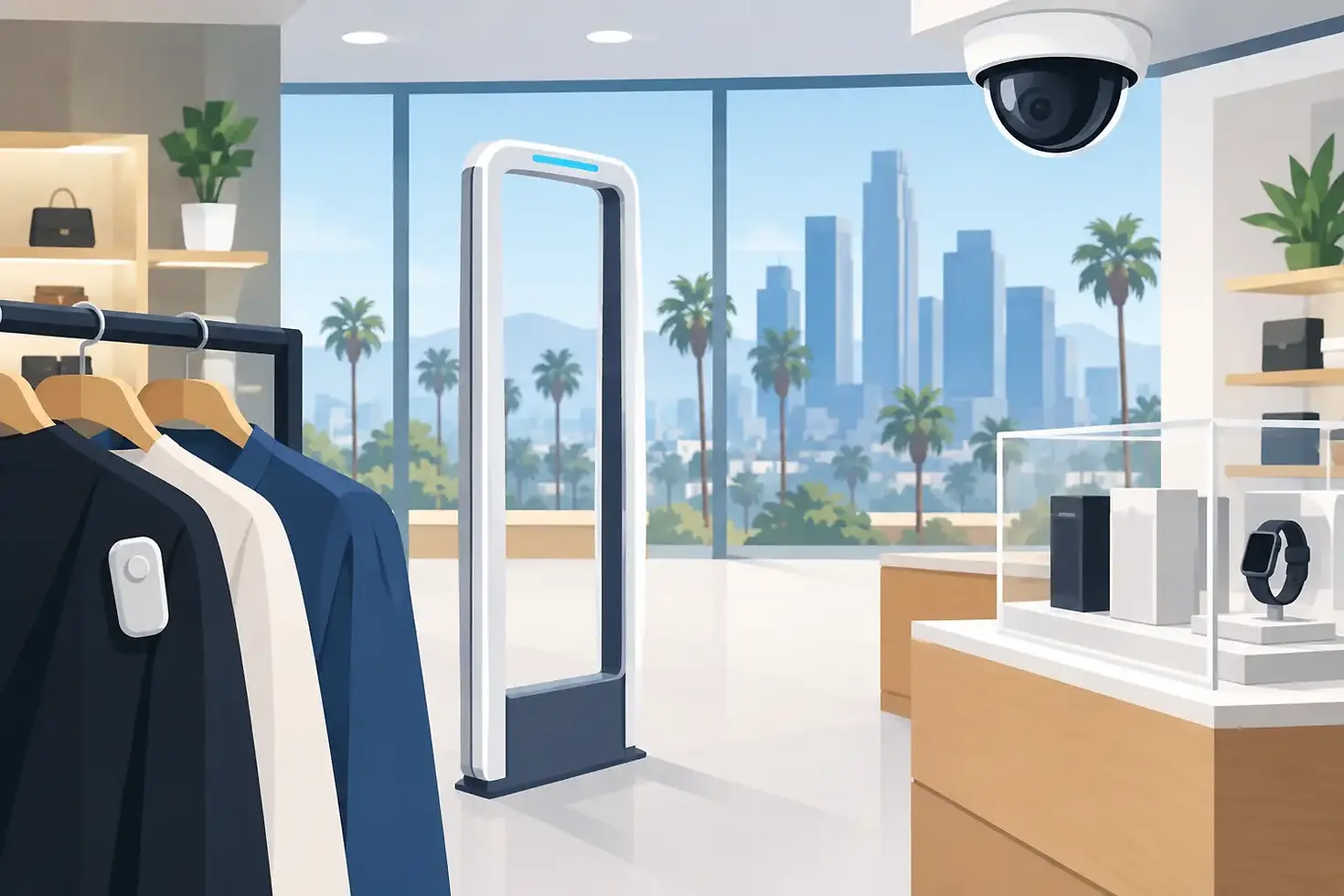
Electronic article surveillance tags, hard tags, cable locks, secured peg hooks, and locked display cases are useful when theft patterns center on specific products. These tools are common in apparel, cosmetics, electronics, liquor, tools, and other high-shrink categories.
Their effectiveness depends on consistent store operations. Tags must be applied correctly, detachers must be controlled, and staff must know how to handle alarms professionally. A locked case without a clear service process can cost sales. An EAS gate that alarms constantly without follow-up becomes background noise.
Use product protection where the loss history supports it. If a small group of high-value products accounts for most shrink, targeted protection is usually more effective than adding friction to the entire store.
Design for Response, Not Just Detection
A security system should help employees make calm, safe decisions. Staff should never be expected to physically confront a suspected thief. Instead, create simple procedures for observing, reporting, preserving video, and contacting management or law enforcement when necessary.
A practical response plan should define who receives alarm alerts, who can access footage, how incidents are documented, and what happens when a camera, door contact, or recorder fails. It should also include regular checks. A disconnected camera, expired storage drive, or blocked view may not be noticed until the footage is needed.
For multi-location operators and property managers, consistency is critical. Standardized camera naming, labeled cabling, secure equipment racks, and documented user access make ongoing support faster. These details may not be visible to customers, but they reduce downtime and confusion during an urgent event.
Choosing the Right Mix for Your Store
The right theft deterrents depend on your store’s layout, merchandise, hours, staffing, and incident history. Start with the areas where loss is most likely or where a single incident would be most damaging. Then build outward.
A small retail shop may need clear entrance coverage, point-of-sale cameras, a monitored alarm, and improved rear-door lighting. A larger operation may also need controlled employee access, loading-dock coverage, multiple viewing stations, and tighter protection around receiving and inventory areas. If theft is tied to a recurring location or time of day, that pattern should drive the design.
Professional installation matters because security components need to work together. Cameras require the right field of view, recording capacity, network configuration, and power. Alarm devices need proper zoning and reliable communication. Access control needs secure doors, accurate permissions, and a plan for emergencies. Cyber Shield Security helps Los Angeles businesses evaluate these details and build systems that are practical to operate after installation.
The best protection is the system your team will actually use and maintain. Start with the vulnerabilities you can verify, make detection visible, and make sure help is available when an incident happens.


