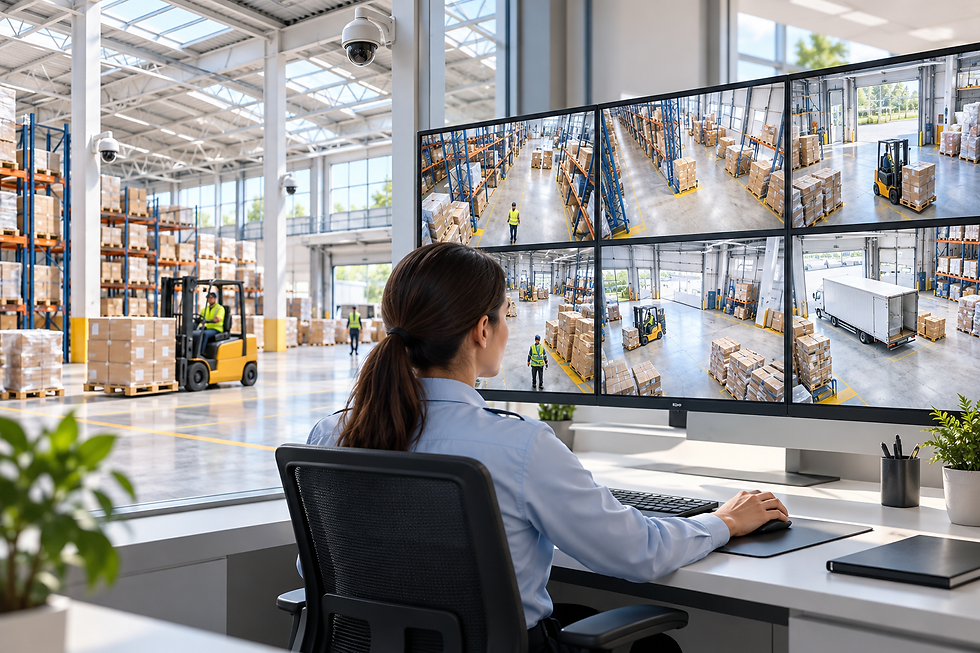
Remote Video Monitoring for Property Management Companies

Property management companies are responsible for protecting buildings, residents, tenants, employees, contractors, and property assets. For managers overseeing multiple properties, traditional security cameras can provide valuable footage—but simply recording video may not be enough.
Remote video monitoring allows trained security personnel to actively monitor cameras and respond to suspicious activity in real time.
For property managers in Los Angeles and surrounding areas, remote video monitoring can provide an additional layer of security for apartment buildings, commercial properties, parking areas, construction sites, HOAs, and other managed properties.
Cyber Shield Security provides security and monitoring solutions designed to help property managers improve visibility across their properties while reducing the need to rely solely on periodic physical checks or recorded footage.

What Is Remote Video Monitoring?
Remote video monitoring is a security service where trained operators watch live security camera feeds from a remote monitoring location.
Unlike a traditional camera system that primarily records footage for later review, remote video monitoring allows operators to identify activity as it happens.
Depending on the system and service, operators may be able to:
Watch live camera feeds
Identify suspicious activity
Verify potential security incidents
Use two-way audio to issue verbal warnings
Follow established escalation procedures
Notify designated property personnel
Document incidents
Review recorded video when necessary
This makes remote video monitoring particularly useful for property management companies that need visibility across multiple locations.
Why Property Management Companies Use Remote Video Monitoring
Property managers often oversee properties that are active throughout the day and night.
Common challenges include:
Trespassing
Unauthorized entry
Theft
Vandalism
Illegal dumping
Parking violations
Property damage
Suspicious activity
After-hours activity
Construction-site security
Common-area incidents
A security camera can capture an event, but someone still needs to review the footage.
Remote video monitoring adds a human layer by allowing trained operators to watch selected cameras in real time.
Remote Video Monitoring vs. Traditional Security Cameras
A traditional security camera system generally records video to a local or cloud-based storage system.
Remote video monitoring adds active observation.
Feature | Recorded Security Cameras | Remote Video Monitoring |
Video recording | Yes | Yes, depending on system |
Live viewing | Usually available | Yes |
Human monitoring | No | Yes |
Real-time incident verification | Limited | Yes |
Two-way talk-down | Depends on equipment | Often available |
Incident escalation | Usually manual | Can follow established procedures |
Remote property visibility | Yes | Yes |
Historical footage | Yes | Yes, depending on system |
A property manager may use both approaches together.
Recorded footage provides evidence and historical visibility, while remote monitoring provides active oversight.
How Remote Video Monitoring Helps Property Managers
1. Provides Real-Time Property Visibility
Property managers may not be physically present at every property they manage.
Remote video monitoring allows operators to observe selected areas remotely.
This can be particularly useful for:
Apartment communities
Commercial buildings
Parking facilities
Retail properties
Construction sites
Vacant properties
HOA communities
Instead of relying entirely on scheduled property visits, management can have an additional layer of visibility throughout the day or night.
2. Helps Deter Trespassing
Visible security cameras can discourage unauthorized individuals from entering restricted areas.
When cameras are actively monitored, suspicious activity can potentially be identified while it is happening.
For example, an operator may observe someone:
Climbing a perimeter fence
Entering a restricted area
Walking around a closed property
Attempting to access a locked building
Entering a construction site after hours
Two-way audio can also allow an authorized operator to issue a verbal warning when the system supports this capability.
3. Helps Reduce Theft Risk
Remote video monitoring can provide an additional layer of protection for properties containing valuable equipment, materials, vehicles, or other assets.
Potentially useful locations include:
Parking lots
Loading areas
Construction sites
Storage areas
Building entrances
Equipment yards
Commercial properties
The objective is to identify suspicious activity as early as possible and follow the property's established response procedure.
4. Helps Protect Vacant Properties
Vacant buildings can be attractive targets for unauthorized entry, vandalism, theft, and illegal dumping.
Property management companies may manage properties that are temporarily vacant because of:
Renovation
Construction
Tenant turnover
Sale
Development
Property damage
Business closure
Remote video monitoring can provide visibility even when there are few or no people regularly present at the property.
Remote Video Monitoring for Apartment Buildings
Apartment communities have multiple areas that may benefit from security camera coverage.
These can include:
Building entrances
Parking garages
Parking lots
Hallways
Mail areas
Pool areas
Amenity spaces
Trash and loading areas
Perimeter entrances
Common areas
Property managers can use remote video monitoring to help identify activity in selected areas, particularly during periods when on-site personnel are unavailable.
For apartment properties, security monitoring should be designed carefully around resident privacy, appropriate camera placement, and applicable laws.
Remote video monitoring is a security service and does not replace required fire alarm systems or life-safety equipment.
Remote Video Monitoring for Commercial Properties
Commercial property managers may need to monitor several types of facilities simultaneously.
Examples include:
Office buildings
Retail centers
Shopping centers
Warehouses
Industrial properties
Medical offices
Business parks
Mixed-use properties
Remote video monitoring can provide centralized visibility into selected locations without requiring the property manager to physically travel to each property.
Remote Video Monitoring for HOAs
HOAs may manage communities containing:
Entry gates
Clubhouses
Pool areas
Parking areas
Private roads
Community amenities
Common areas
Remote video monitoring can help provide additional visibility into these locations.
HOAs should establish clear policies regarding camera placement, privacy, access to footage, retention, and authorized use of recorded information.
Remote Video Monitoring for Construction Sites
Construction sites can be particularly challenging to secure because they often contain valuable materials and equipment while having limited personnel after working hours.
Potential risks include:
Material theft
Equipment theft
Trespassing
Vandalism
Unauthorized dumping
Property damage
Remote video monitoring can allow operators to watch important areas such as:
Site entrances
Equipment storage
Material staging areas
Perimeter fencing
Jobsite trailers
Parking areas
For developers and general contractors in Los Angeles, remote monitoring can be part of a broader construction-site security strategy.
Can Remote Video Monitoring Replace Security Guards?
Not necessarily.
Remote video monitoring and on-site security guards serve different purposes.
A security guard can physically patrol a property, interact with people, inspect areas, and respond on-site.
Remote video monitoring provides centralized observation and can help identify and verify activity remotely.
Some property managers may use:
Security guards
Remote video monitoring
Access control
Security cameras
Alarm systems
together as part of a broader security strategy.
The appropriate combination depends on the property and its security requirements.
How Two-Way Talk Helps Remote Video Monitoring
Some monitored camera systems include two-way audio.
When available, an authorized monitoring operator can use the camera's speaker to communicate with individuals at the property.
For example:
"This area is monitored. You are not authorized to be here. Please leave the property."
This type of talk-down can provide an immediate response to certain situations.
It may be useful for:
Trespassing
Unauthorized parking
After-hours activity
Restricted areas
Construction sites
Vacant properties
Two-way audio does not replace emergency services or physical security personnel when an incident requires an on-site response.
What Can Remote Video Monitoring Detect?
The exact capabilities depend on the camera system, monitoring service, camera placement, lighting, analytics, and site conditions.
Potentially detectable activity can include:
Human Activity
People entering restricted areas
Perimeter breaches
Trespassing
Suspicious movement
Vehicle Activity
Unauthorized vehicles
Vehicles entering restricted areas
Suspicious parking activity
After-hours vehicle movement
Property Conditions
Operators may also observe:
Open gates
Damaged fencing
Unusual activity
Property damage
Other conditions visible through the cameras
Human monitoring can provide context that automated alerts alone may not provide.
Can Remote Video Monitoring Work With Existing Security Cameras?
In many cases, yes.
Whether an existing camera system can be used depends on:
Camera manufacturer
Camera model
Video format
Network connectivity
Recording platform
Camera resolution
Available bandwidth
Remote-access capabilities
Compatibility with the monitoring platform
An assessment can determine whether existing cameras can be integrated or whether upgrades are necessary.
Property managers should not assume that replacing every camera is required.
Can Remote Video Monitoring Work With an Alarm System?
Yes. Remote video monitoring can potentially be integrated with other security systems.
Depending on the system, alarm events can help direct attention to a particular location.
For example:
Alarm Event → Camera View → Video Verification → Appropriate Response
This can provide additional visual information about what is happening at the property.
The exact integration depends on the alarm system, cameras, monitoring platform, and configuration.
Remote Video Monitoring and Fire Alarm Systems
Remote video monitoring and fire alarm monitoring are not the same service.
A security camera can visually identify smoke, flames, or unusual activity in some circumstances, but it should not be treated as a replacement for a required fire alarm system.
Fire alarm systems are specifically designed to detect and communicate fire-related conditions through approved life-safety equipment.
In Los Angeles, LAFD reviews fire/life-safety systems, including fire alarm systems, for applicable construction, remodeling, and other projects.
LAFD also publishes testing requirements for fire protection systems, including basic and complex fire warning systems and central station signaling systems.
Property managers should therefore treat security video monitoring and fire alarm monitoring as separate but potentially complementary systems.
Remote Video Monitoring and Fire Alarm Installation
Property managers often manage multiple building systems at the same time.
A property may require:
Security cameras
Remote video monitoring
Access control
Burglar alarms
Fire alarm systems
Fire alarm monitoring
Intercom systems
Other low-voltage systems
During a renovation or tenant improvement, coordinating these systems early can help prevent conflicts.
LAFD's plan-review process covers fire/life-safety systems such as fire alarms for applicable construction and remodeling projects.
If a project involves modifications to an existing fire alarm system, the fire alarm scope should be evaluated separately from the security-camera scope.
How Much Does Remote Video Monitoring Cost in Los Angeles?
There is no single price for every property.
Remote video monitoring costs can depend on:
Number of cameras
Number of monitored locations
Monitoring hours
Camera capabilities
Existing camera infrastructure
Video storage requirements
Network connectivity
Two-way audio
Alarm integration
Site conditions
Installation requirements
Number of properties being monitored
A property manager overseeing multiple buildings may also need a centralized monitoring strategy.
The best way to estimate cost is to evaluate the existing security system and determine which locations require active monitoring.
How Property Management Companies Can Get More Value From Video Monitoring
A successful remote video monitoring program starts with clearly identifying what needs to be monitored.
Identify High-Risk Areas
Prioritize locations such as:
Entrances
Parking lots
Garages
Perimeters
Equipment areas
Loading zones
Vacant spaces
Establish Response Procedures
Property managers should determine:
Who should be contacted
When management should be notified
When security personnel should be dispatched
When emergency services should be contacted
How incidents should be documented
Review Camera Placement
Cameras should provide useful views without unnecessarily capturing areas where privacy is expected.
Maintain the Equipment
Cameras, networking equipment, recording systems, and monitoring hardware should be regularly checked.
Remote Video Monitoring for Los Angeles Property Managers
Los Angeles property managers oversee a wide variety of properties, from apartment communities and commercial buildings to construction projects and mixed-use developments.
Remote video monitoring can provide additional visibility for properties throughout:
Los Angeles
North Hollywood
Studio City
Burbank
Sierra Madre
Arcadia
Pasadena
Woodland Hills
Sherman Oaks
Santa Monica
Beverly Hills
West Hollywood
Los Angeles property managers should also consider the difference between security monitoring and life-safety systems.
For example, LAFD's published high-rise fire/life-safety requirements include provisions for alarm and trouble signals to be annunciated at a 24-hour attended remote location for applicable systems.
Security video monitoring can complement those systems, but it does not replace required fire alarm infrastructure.
Why Choose Cyber Shield Security?
Property management companies need security solutions that work across different properties and operating conditions.
Cyber Shield Security can help property managers evaluate their existing security infrastructure and identify opportunities for improved monitoring and visibility.
Depending on the property, services may include:
Security camera installation
Remote video monitoring
Live video monitoring
Two-way talk-down
Video verification
Security system integration
Access control
Burglar alarm systems
Fire alarm installation
Fire alarm monitoring
System upgrades
Troubleshooting and service
The goal is to create a practical security strategy based on the property's layout, operating hours, risks, and management requirements.
Frequently Asked Questions About Remote Video Monitoring
1. What is remote video monitoring?
Remote video monitoring is a security service where trained operators actively watch live security camera feeds from a remote location and respond according to established procedures.
2. Is remote video monitoring better than security cameras?
They are different solutions. Security cameras can record and provide video evidence, while remote video monitoring adds active human observation. Many properties use both.
3. Can remote video monitoring prevent trespassing?
It can help deter and identify trespassing by providing active observation and, where available, two-way talk-down. The appropriate response depends on the property's procedures and the situation.
4. Can property managers monitor multiple properties remotely?
Yes. A centralized monitoring strategy can allow property managers and monitoring personnel to oversee camera systems across multiple locations, depending on the equipment and monitoring platform.
5. Can remote video monitoring work with existing cameras?
In many cases, existing cameras can be integrated, but compatibility must be evaluated. Camera technology, network connectivity, recording systems, and monitoring-platform requirements can affect integration.
6. Does remote video monitoring replace security guards?
Not necessarily. Remote monitoring and on-site guards perform different functions and can be used together depending on the property's security needs.
7. Does remote video monitoring replace a fire alarm system?
No. Security cameras and remote video monitoring do not replace required fire alarm systems or fire alarm monitoring.
8. How much does remote video monitoring cost in Los Angeles?
Costs vary based on the number of cameras, monitoring hours, properties, equipment, integration requirements, network infrastructure, and other project factors. A property assessment is needed for an accurate estimate.
Protect Your Properties With Remote Video Monitoring
Managing multiple properties means you cannot be everywhere at once.
Remote video monitoring gives property management companies an additional layer of real-time visibility, helping them identify suspicious activity, monitor high-risk areas, verify incidents, and improve security oversight across their properties.
Whether you manage an apartment building, commercial property, HOA community, construction site, office building, retail center, or multiple properties, Cyber Shield Security can help evaluate your current camera and security setup.
Remote video monitoring can also be coordinated with other security solutions, including security cameras, access control, burglar alarms, and fire alarm systems, when appropriate.
Contact Cyber Shield Security
Phone: (310) 242-3100Email: info@cybershieldsecurity.us
Serving Los Angeles, North Hollywood, Studio City, Burbank, Sierra Madre, Arcadia, Pasadena, Woodland Hills, Sherman Oaks, Santa Monica, Beverly Hills, and West Hollywood.
Need better visibility across your properties? Contact Cyber Shield Security today to discuss remote video monitoring and a security solution designed around your property's needs.